autumn

PGM 1433 “THE ATMOSPHERIC FLUTE” : nov. 6-13

Combining traditional acoustic instruments and spatial electronic sound

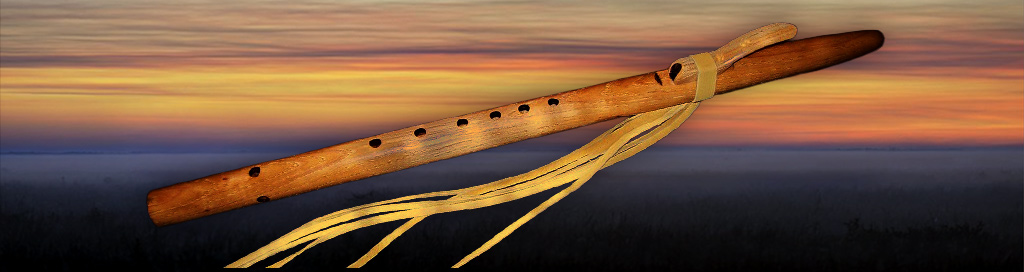
The timeless sound of the Native American flute… With a history that goes back to the Paleolithic era over fifty thousand years ago, primeval flutes—along with primitive drums and string instruments—played a formative role in the evolution of music in ancient world cultures.

Simplicity, portability, and playability were key to flute longevity. In the ancient world, flutes were made from natural materials—soft cedar wood; reeds and grasses like bamboo; bird, animal, and human bones; and ivory from the tusks of mammoths and other large animals. They were easy to make—just an open tube with handmade holes to change the pitch.

Interest in Native American culture led to the founding of Canyon Records for authentic Native American music in 1951. In the 1970’s and 80’s, the native flute was adopted by New Age and other non-native musicians, who focused on relaxation and healing. Today, Ambient musicians are exploring the creative combination of traditional acoustic instruments like the native flute and spatial electronic sound.

On this transmission of Hearts of Space, a program called “THE ATMOSPHERIC FLUTE.” Music is by ANTHONY WAKEMAN and MR.SOON, BYRON METCALF, VIANNEY LOPEZ. BROTHER TRIBE, JOANNE LAZZARO, PETER PHIPPEN, ANN LICATER, and SCOTT AUGUST.
[ view playlist ]   [ view Flickr image gallery ]

PGM 927R “RUSSET and AMBER” : oct.30-nov.5

The darkening colors of autumn…the dark harmonies and plaintive tones of the cello

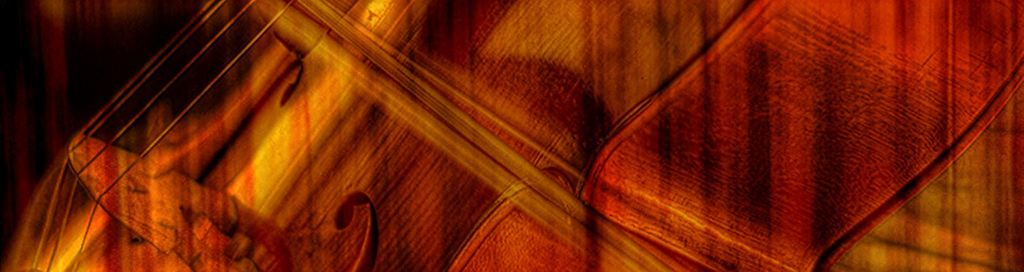
IN THE HISTORY OF BRILLIANT UNINTENDED CONSEQUENCES, the cello ranks high. A descendant of the bass violin, it was invented by Italian luthiers in the 17th century, and based on a technical innovation: to make the instrument smaller, they wrapped gut strings with wire to augment the bass.

The cello’s musical roles expanded rapidly in the 18th century due to its more convenient size and versatility. Today, no western instrument has the emotional range and depth; from its foundational role in the orchestra and the string quartet, to its uncanny vocal emulations and profound solo flights…the cello seems to have no boundaries.

On this transmission of Hearts of Space, we feature the dark harmonies and plaintive tones of the cello, on an autumnal soundscape called “RUSSET and AMBER.” Music is by the late DAVID DARLING, MARTIN TILLMAN, HANS CHRISTIAN, MAYA BEISER, and ANGÉLE DUBEAU and LA PIETÀ.

[ view playlist ]   [ view Flickr image gallery ]

PGM 1407R “DESCENDING DUSK” : oct.16-23

Ambient-Classical atmospheres and introspections for autumn

AUTUMN ARRIVES QUIETLY, with less drama than other seasons: a gradual slowing of the solar-powered activity of summer, accompanied by a subtle cooling of the air and dimming of the light, as the sun moves south for the winter.

In contrast, the animal world is all activity-a flurry of preparation for the challenges of the season to come-while the changing colors of the leaves signals a silent chemistry of decay and transformation that fuels the next generation of plants, and feeds the animals with fruits and seeds.

For ambient composers, it’s time to explore slower tempos, darker harmonies, descending progressions, the bittersweet timbres of the woodwind family, and the metallic overtones of bells and horns.

On this transmission of Hearts of Space, Ambient-Classical atmospheres and introspections for autumn, on a program called “DESCENDING DUSK.” Music is by THE AMNIS INITIATIVE, DEEPSPACE, DEBORAH MARTIN and JILL HALEY, CHRISTIAN WITTMAN, GEORGE WALLACE, and ISHQ.

[ view playlist ]   [ view Flickr image gallery ]

PGM 1431 “INTANGIBLE HERITAGE” : oct. 9-16

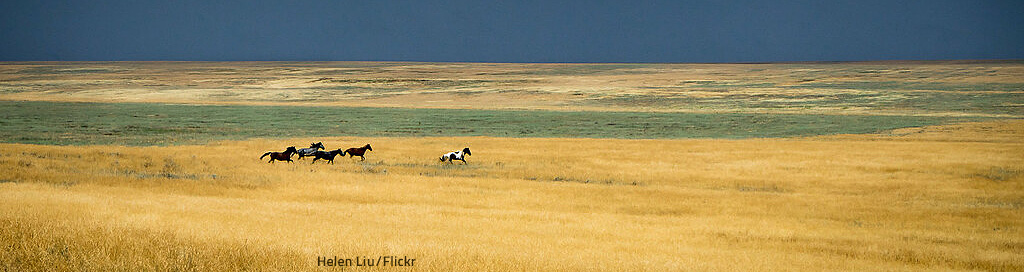
A Journey on the Great Eurasian Steppe

The softly rolling hills and endless grasslands of “The Great Eurasian Steppe” are home to the mournful, archaic tones of the Armenian duduk—a more soulful member of the double reed family of woodwind instruments, like the western oboe and English horn.

A “steppe” is an eco-region of grassland plains with no trees except next to rivers and lakes. “The Great Eurasian Steppe” is the world’s largest, extending some 5,000 miles from today’s Eastern Europe, across Russia and the “stan” countries of Central Asia, through Manchuria and Mongolia to the western edge of China.

Since the Middle Paleolithic era over 100,000 years ago, the Eurasian Steppe has been the main overland route between Europe and Asia—the much older economic, political, and cultural predecessor of the more famous Silk Road, which matured during the Middle Ages.

In 2005, UNESCO (The United Nations Educational, Scientific and Cultural Organization) proclaimed the Armenian duduk and its music a “Masterpiece of the Intangible Heritage of Humanity,” along with other traditional creations of cultural communities.

On this transmission of Hearts of Space from our friendly Canadian guest producer D.J. EGAN, a program inspired by the ethno-ambient music of the Great Eurasian Steppe, with influences and instruments from ARMENIA, GREECE, TURKEY, LITHUANIA, FINLAND, and RUSSIA, and music by ARA DINKJIAN, SAVINA YANNATOU & PRIMAVERA EN SALONICO, DMITRY SOUL, DELAYMAN, SANS, SAULIUS PETREIKIS + RASA SERRA + THE UNIT 7 ALLSTARS, C.DIAB, and TWILIGHT TAPES.

/[ view playlist ]   [ view Flickr image gallery ]

PGM 1231R “FALLING” : oct. 2-9

THE SUN begins its long withdrawal from the northern hemisphere after the summer solstice in June. After the autumn equinox in September, the transition seems to accelerate. The days grow shorter, the nights grow longer, and the temperature cools, while the natural world changes color and prepares for the winter to come.

Since medieval times we’ve called this season “fall.” The word comes from Middle English, with Old English and Old German roots. Falling implies movement downward, and in autumn, declining solar energy brings a feeling of descending or falling into the season. In music it’s marked by slowing tempos, descending chord progressions, darkening timbres, and wistful, even melancholy emotions.

On this transmission of Hearts of Space…we descend into the autumn soundscape, a program called “FALLING.” Music is by DAVID DARLING, JOEP BEVING, CHRISTOPHER TIGNOR, HAMMOCK, LUDOVICO EINAUDI, and TOM EATON.

[ view playlist ]   [ view Flickr image gallery ]

PGM 1357R ‘AUTUMN TWILIGHT’ : nov.14-21

Of all the seasons, fall is the one that comes with the most mixed emotions: relief at the return of moderate temperatures, pleasure at nature’s autumn color show, and a feeling of melancholy at the darkening of the light.

Technical interventions like Daylight Saving Time can’t hide the fact that the amount of daylight is decreasing. In the northern hemisphere, we’re counting down to the Winter Solstice—the shortest day of the year, around December 21st.

For ambient musicians, fall offers a darker palette, more somber harmonies, and a call to explore deeper feelings. On this transmission of HEARTS of SPACE, we descend into the dimming light of fall, on a program called “AUTUMN TWILIGHT.”’

Music is by TOM EATON, BOB HOLROYD, SUBDREAM, DEEPSPACE, STEVE ROACH, and RUSSEL WALDER.

[ view playlist ] [ view Flickr image gallery ]

PGM. 1331R ‘CELLO ELEGIES 2’ : oct.31-nov.7

Mournful…plaintive…melancholy…somber…sonorous…resonant.

The cello is all this and more — a compact, versatile string orchestra in one instrument, with a four-octave range that comes fully alive in the dark days of autumn. On this transmission of Hearts of Space, it’s an autumn journey featuring the plangent tones of the cello, on a program called “CELLO ELEGIES 2.”

Music is by DAVID DARLING, HANS CHRISTIAN, MAYA BEISER, BLACK TAPE for a BLUE GIRL, ERALDO BERNOCCHI & HOSHIKO YAMANE, JESSE AHMANN, MAX RICHTER, and MARCELLO DE FRANCISCI.

[ view playlist ] [ view Flickr image gallery ]