
New Programs

PGM 1373 ‘CHANTRESS SEBA’ : may 31-apr.7

If there’s a contemporary musical group that demonstrates the enormous changes that have overtaken the music business in the last 20 years, it’s the husband and wife team of singer GEMINI FOWLER, and guitarist & “handpan” player FINN MILBURN, together known as CHANTRESS SEBA.

They emerged from the north England city of Leeds, a vibrant area, but not one known for musical innovation. Nevertheless, they’ve been able to attract a worldwide audience of millions–and they’ve done it while completely ignoring the established music business.

Their main publishing and streaming platform is YouTube, where by mid-2024 they have 22 one-hour-plus “long form” videos available, which have attracted from a few hundred thousand to 3.9 MILLION views!

By taking full advantage of the internet, they’ve reinvented New Age music. Streaming on YouTube and promotion on social media have replaced all the functions of a conventional record company, providing a worldwide platform for their entrancing live performances, without the compromises and loss of control of a conventional recording contract.

Their music is peaceful, harmonious, and contemplative. Here’s how they describe it:

“CHANTRESS SEBA, Singer of the Stars, a voice to guide us home to our hearts. Gemini’s powerful ethereal vocals and channeled light language from the shining stars above, combined with Finn’s earthy, spacious instrumentation, create an atmosphere of deep remembering, allowing the divine to speak to the listener through mind, body, and soul.” “We create music, host ceremonies and gatherings, and provide 1 to 1 shamanic sound healing.”

It’s a long-form journey from one of the new frontiers of new age music: CHANTRESS SEBA…on this transmission…of Hearts of Space.

[ view playlist ] [ view Flickr image gallery ] [ play 30 second MP3 promo ]

PGM 1372 ‘ELECTRON FLOW’ : may 17-24

Electronic music has come a long way in the last 50 years. Beginning in the 1960s, the arrival of affordable mass-produced analog and digital synthesizers liberated electronic music from the rigidity of academic laboratories, the iconoclasm of avant-garde theories, and the dogmas of experimental music. Equipped with powerful instruments and their own recording studios, electronic musicians were free to take ideas and influences from all kinds of popular and historical music, leading to a fruitful period of cross-fertilization, invention, and collaboration.

Early electronic instruments were notably lacking in musical expression, but they proved to be exceptionally good at creating the impression of flying and floating in vast virtual spaces. On this transmission of Hearts of Space, we fly on electronic winds and float on electronic clouds, on a program called ELECTRON FLOW.

Music is by GEORGE WALLACE, CHRONOTOPE PROJECT, COPAL RIVER, ROBERT SCOTT THOMPSON, STEVE ROACH, ANDREW LAHIFF, STEVE BRAND, and ADHAM SHAIKH.

[ view playlist ] [ view Flickr image gallery ] [ play 30 second MP3 promo ]

PGM 1371 ‘HARMONIC WORLD’ : may 3-10

“In turbulent times, ambient world musicians project calm and harmony.”

It’s an instinctive response to our super-charged environment, a way to transmute chaos and instability into order, reduce anxiety, restore regular breathing, and take down the temperature. Perhaps more remarkable, even in our electronic era, they do it mainly as they have for centuries — with traditional acoustic instruments and consonant harmonies.

On this transmission of Hearts of Space, a transcultural acoustic fusion of influences from South America, Jamaica, North Africa, the Middle East, Indonesia, and India — on a program called HARMONIC WORLD. Music is by SUZANNE TENG & GILBERT LEVY, STEPHAN MICUS, AUKAI, SHANTALA, CHANTRESS SEBA, and MIRABAI CEIBA. 

[ view playlist ] [ view Flickr image gallery ] [ play 30 second MP3 promo ]


PGM 1370 ‘TRANSLUCENT GUITARS 2’ : apr.19-26

If you’ve driven an electric car, you’ve experienced the feeling of smooth, silent power that conveys you almost effortlessly to your destination. Something similar happened to the venerable Spanish guitar when it got an electronic upgrade in the 20th century. In just a few years, a charming but limited folk instrument became a powerhouse — a vehicle for everything from heroic flights to subtle meditations.

On this transmission of Hearts of Space, we ride our favorite six string transporter to ethereal realms, on a program called ‘TRANSLUCENT GUITARS 2’  Music is by ERIK WØLLO, DAVID HELPLING, HAMMOCK, JOHN GREGORIUS, JEFF PEARCE, CLIVE WRIGHT & HAROLD BUDD, CHUCK JOHNSON, and TOM CAUFIELD. 

[ view playlist ] [ view Flickr image gallery ] [ play 30 second MP3 promo ]

PGM 1369 ‘TOTALITY’ : apr.5-12

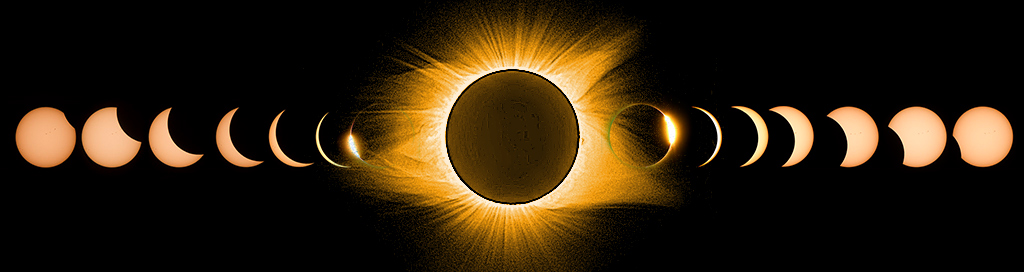
It’s being called the “astronomical event of the decade.” If you live in the middle third or the northeastern quarter of the United States—on a line from Texas to Maine—there’s a good chance that a total solar eclipse of the sun will be visible on the afternoon of April 8th, 2024. Depending on the exact location, the darkening and cooling within the moon’s shadow or “umbra” only lasts from two to seven and a half minutes, because the umbra moves across the earth’s surface at over 1100 miles per hour.

Surprisingly, solar eclipses are not that rare. There are at least two, and up to five, somewhere on earth each year. For millennia, solar eclipses were attributed to supernatural causes or regarded as evil omens. Modern astronomers have taken most of the mystery and superstition—but not the strangeness and thrill—out of eclipses. They can now be accurately predicted hundreds of years into the future, but they still have a cosmic appeal that attracts millions of viewers and a worldwide community of “umbraphiles.”

On this transmission of Hearts of Space, music for a total eclipse of the sun, on a program called TOTALITY. Music is by CHRONOTOPE PROJECT, SUBDREAM, STELLARIUM, LONEWARD, ZENON MARKO, ROBERT RICH, and STEVE ROACH.

[ view playlist ] [ view Flickr image gallery ] [ play 30 second MP3 promo ]

PGM 1368 ‘SACRED SONGS of DEVOTION’ : mar.29-apr.5

This week on Hearts of SpaceSACRED SONGS OF DEVOTION”a special program of choral and instrumental music for Easter, from our longtime guest producer for classical and sacred music ELLEN HOLMESThe show includes choral selections from Ellen’s compilation “SACRED SONGS of MARY: Devotion”the third in her series of albums showcasing music honoring the Virgin Mary, mother of Jesus. In Western culture,” writes Ellen, “Mary is the personification of tenderness, compassion, forgiveness, protection, and unconditional loveemotions reflected in music praising her or beseeching her comfort and help.

This wide-ranging program includes sacred choral music from the Russian Orthodox mass, a 12th Century song by HILDEGARD VON BINGEN, 17th century sacred music from Spain by ALONSO LOBO, sacred works by 19th and 20th century composers JOHN TAVENER, SERGEI RACHMANINOFF, PYOTR ILYICH TCHAIKOVSKY, and MAURICE DURUFLÉ, and contemporary works by SIGUR RÓS, LISA GERRARD, DAVID DARLING, MAX RICHTER, and ARVO PÄRT. 

Choral and instrumental music for Easter: SACRED SONGS OF DEVOTIONon this transmission of Hearts of Space.

[ view playlist ] [ view Flickr image gallery ] [ play 30 second MP3 promo ]
PGM 1367 ‘VIBRAPHONICS’ : mar.15-22

The Vibraphone is an instrument in the metallophone family with a colorful history of American invention and competition.

Metallophones evolved from the wooden marimba. The predecessor of the vibraphone called the steel marimba, was invented by the J.C. DEAGAN company in Chicago around 1916. The first “vibraphone” was introduced in 1924 by LEEDY Manufacturing in Indianapolis. It was based on the Deagan steel marimba, and featured a vibrato effect created by a motor-driven fan inside the resonator tubes below each note. Not to be outdone, three years later the Deagan Company introduced an improved vibraphone, with better sounding tuned aluminum bars, and a damper mechanism operated by a foot pedal. It was an immediate success and became the model for all subsequent vibraphones.

By the 1930’s the instrument was well-established in the burgeoning jazz scene at the hands of virtuoso players like Lionel Hampton. In addition to jazz, the vibraphone became part of the standard classical orchestra percussion section, and the standard college-level percussion performance curriculum. In the 1970’s this led to use of vibraphones and marimbas in contemporary Minimalist music by Philip Glass and Steve Reich, and later in New Classical and Ambient. That’s where we’re going on this transmission of Hearts of Space, called VIBRAPHONICS.

Music is by GARY BURTON & CHICK COREA, PETER GARLAND, JASPON TREUTING, HANG MASSIVE, MICHAEL JON FINK, OLIVIÉR ALARY, OCEAN MOON, and GARY BURTON & PAUL BLEY.  

[ view playlist ] [ view Flickr image gallery ] [ play 30 second MP3 promo ]

PGM 1366 ‘ELECTRON TRAVELER 6’ : mar.1-8

The current boom in “immersive media” includes computer-assisted VR or Virtual Reality, AR or Augmented Reality, AR and VR glasses and headsets, immersive video games and films, panoramic projections, spatial audio systems, and specially designed theaters and concert venues, like The Sphere in Las Vegas. Regardless of size or complexity, they all have a similar purpose: to augment our existing world, or transport us to fantastic new synthetic worlds.

Interactivity and connectivity are the focus of these new technologies, but there’s an older, simpler, more passive technology that can transport listeners to virtual worlds just by listening—electronic music.

It’s been over a hundred years since the invention of practical electronic instruments, and the power of electronic sound to take us to exotic tonal and even cosmic environments is well-known to both musicians and listeners. On Hearts of Space, we’ve been documenting it for over 40 years, with hundreds of programs dedicated to the art of virtual travel on electronic waves. On this transmission of Hearts of Space, it’s another journey in our electronic touring series, on a program called ELECTRON TRAVELER 6. Music is by THIERRY DAVID, MARTIN STÜRTZER, DREAMSTATE LOGIC, SUBDREAM, CHRONOTOPE PROJECT, STEVE ROACH, and ALPHA WAVE MOVEMENT.

[ view playlist ] [ view Flickr image gallery ] [ play 30 second MP3 promo ]

PGM 1365 ‘EUROJAZZ’ : feb.16-23

The British jazz saxophonist and clarinetist JOHN SURMAN has a style that’s described as “intensely lyrical,” a quality he attributes to his time as a choirboy, and his upbringing in the verdant landscapes of rural west England. Surman sees the 20th century origins of jazz by black musicians in the U.S. as a melting pot of world music, with African, Creole, Spanish and other influences. These were eventually transformed into the speed and virtuosity of Bebop, which dominated jazz at mid-century.

Between the world wars, Europe had become a major venue for American jazz musicians. The genre took on influences from European folk and classical music, as well as a wider range of world influences from the Middle East, Central Asia, and South America. As a result, European jazz tended to be less abstract, more melodic, and more atmospheric than American jazz. The essential German jazz and New Music label ECM, founded in 1969, continues to document this repertoire in a catalog of over 1800 superb recordings, from which this program is drawn.

On this transmission of Hearts of Space, lyrical jazz from Europe with a focus on Norway, a small country that produces a remarkable amount of great music, on a program called EUROJAZZ. Music is by the TORD GUSTAVSEN QUARTET, TERJE RYPDAL, JOHN SURMAN, ARVE HENRIKSEN & HARMEN FRAANJE, THOMAS STRØNEN, CRAIG TABORN, and KRISTJAN RANDALU with BEN MONDER and MARKKU OUNASKARI. 

[ view playlist ] [ view Flickr image gallery ] [ play 30 second MP3 promo ]

PGM 1364 ‘ATMOSPHERIC CLASSICAL’ : feb.2-9

The evolution of western classical art music is a story of evolving cultures, developing instruments, and continuous musical innovation. Over the course of some twelve centuries, acoustic strings, winds, horns, keyboards, and percussion instruments evolved into the symphony orchestra, as well as smaller groups: string orchestras, horn and wind ensembles, and intimate string quartets, trios, and duos. Each group was designed for a specific kind of music and social occasion.

The arrival of electronic instruments in the 20th century was a disruptive innovation that stimulated a different response than the slow evolution of acoustic instruments. Electronics promised the composer freedom from acoustic limitations, the ability to design completely new tones and new instruments, create spatial sound images and virtual environments. In time, these new capabilities led to new genres like Electronic Space and Ambient, with expansive cosmic spaces, infinite floating worlds, and subtle textures.

On this transmission of Hearts of Space, we explore the intersection of classical form and ambient electronics, on program called ATMOSPHERIC CLASSICAL. Music is by MAX RICHTER, A WINGED VICTORY FOR THE SULLEN, CHRISTIAN WITTMAN, HAMMOCK, JÓHANN JÓHANNSSON and JONAS COLSTRUP, WILLLIAM ST. HUGH, and BOB HOLROYD.

[ view playlist ] [ view Flickr image gallery ] [ play 30 second MP3 promo ]