Irish music writer MARK PRENDERGAST, author of the definitive book on Ambient music "The Ambient Century," has written an update to the book in the form of a series of articles in the English Hi-Fi Critic magazine. Following up his address at our AMBIcon 2013 Conference last May, Mark wrote the following piece, which covers new work in Europe and in the U.S.
— :: SH
The Ambient Odyssey: Part 2 (PDF)
The Ambient Odyssey
Part 2-New Possibilities: Ambient In The 21st Century
The great euphoric rush which accompanied the end of the 20th century was replaced very soon by the earth-shattering events in New York City of September 2001. The Age of Uncertainty was back and music as we'd known it was changed forever. Ambient turned in on itself, becoming spare, isolationist, environmental, arty and philosophical.
High-profile pop figures like John Foxx, David Sylvian and Brian Eno had flirted with the idea of installation music for years. Eno's Place Nos 11-16 were defining sound installations of the late 20th century. But it wouldn't be until the 21st century that "sound art," a discipline which explores the spaces between hearing, listening, perception and environment would take off. Pauline Oliveros, Terry Fox, Alvin Lucier, Bill Fontana, Paul Horn and Toru Takemitsu would all have a huge influence. Soon "sound sculpture" and "sonification" became buzz words. The quartet of Douglas Henderson, Boris Hengenbert, Michael J. Schumacher and Agostino Di Scipio made a huge splash in 2008 at the inaugural exhibition of the Mazzoli Gallery, Berlin, a purpose-built sound art space. In 2010 it arrived big time in the UK when Susan Philipsz won the Turner Prize for Lowlands — a series of intertwined Scottish laments played in variable versions through a loudspeaker system.
Back in the studio, musicians and visionaries kept mining the Ambient seam, but in isolation, no longer part of global movement. One couldn't get more remote than 217 miles inside the Arctic circle; Tromsø in Norway to be precise, the home of GEIR JENSSEN, better known today as BIOSPHERE. A dedicated outdoor skier and mountaineer, Jenssen brought the landscape of Scandinavia to his music which is full of translucent Arctic sounds. In 1997 he was signed to All Saints Records (an offshoot of Eno's Land and Opal projects) and Substrata was released to worldwide critical acclaim. Beginning with the sound of a lone aircraft, along the way we hear samples from David Lynch's Twin Peaks, Russian broadcasts, the customary bird noises, wind, rain and crackling fires. It reminds one of the films of Andrei Tarkovsky but there is a uniqueness to the sound. In 2001 Substrata was voted the greatest Ambient album in the history of the genre and was re-issued alongside Man With A Movie Camera with extra tracks. All latter day Biosphere music is worthwhile, especially 2002's Shenzhou, a brilliant re-working of Debussy utilizing samples from old scratched records.
Mining the isolationist furrow were other innovators — Thomas Koener, Paul Schutze, Mark Van Hoen, Scanner and The Black Dog (especially on their 2010 Music For New Airports). All made worthwhile Ambient, all had their audience. In Britain in the 21st century, two artistic collectives would push Ambient into the mainstream. They were called BOARDS OF CANADA and MARCONI UNION.
Describing their music as oneiric (relating to dreams) Marcus Eoin and Mike Sandison of Boards of Canada based themselves in rural Scotland and avoided cities, the press, and the hype of the London music scene. Accepting of terms like chillwave they disliked the word ambient being applied to their work. Inspired namers of recordings, their first proper album Music Has The Right To Have Children (1998) was followed by the intriguing EPs In A Beautiful Place In The Country (2000) and Trans Canada Highway (2006). Their music blossomed on The Campfire Headphase (2005) and I (2013). The New York Times greeted the latter album with the description "discretionary Ambience." It's odd stuff — with beat structures similar to Aphex Twin, often the music is pure tonal athmosphere derived from old malfunctioning equipment. They admit to loving psychedelia, especially The Beatles, the Incredible String Band, the Cocteau Twins and 'the sounds between notes." They could be termed sound collagists and much of their work echoes Cabaret Voltaire or Throbbing Gristle at their best. There is a cerebral intensity to their sound, a kind of lost world. They prefer absence to presence, their last gig was a secretive playback of Tomorrow's Harvest in the Southern Californian desert on May 27th 2013!
Producing wonderfully consonant records of uplifting beauty, Manchester's MARCONI UNION are the exact opposite of BOC in terms of approach. A trio of Richard Talbot, Jamie Crossley and Duncan Meadows play live ambient – keyboards, guitar , drums and effects. Highly melodic, the band were discovered by All Saints' Dominic Norman-Taylor and kicked off with the superb Distance in 2005, citing Eno, Miles Davis and Martin Hannett's spidery production of Joy Division. Albums like A Lost Connection (2008) and Different Colours (2012) are vintage Union but Richard Talbot considers Beautifully Falling Apart (2011) to be their most genuinely Ambient album as it was subtitled Ambient Transmissions. In 2010 Marconi Union played a 150-minute set of improvised Ambient behind a glass atrium at Manchester's City Art Gallery. In 2011 came their biggest coup, Weightless, an 8-minute composition done in collaboration with the British Academy of Sound Therapy. According to scientists it produced a 65% reduction on anxiety. Though full of piano, field recordings and sound manipulation it's the hypno-beat which characterizes. Its worldwide impact was so great that Time magazine considered the Union to be one of the great inventors of the new century.
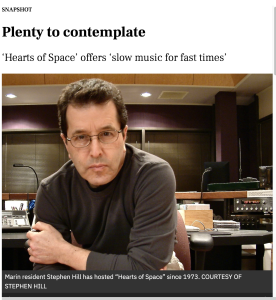
Until May 2013, the American Ambient scene was all but unknown in Europe. Having lectured at AMBIcon in Marin County, California, the first Ambient festival ever held in the U.S.A. I have to say the scene over there is in many ways healthier and much more experimental than what is happening on this side of the Atlantic. AMBIcon was the brainchild of STEPHEN HILL, America's very own Ambient guru. As the inventor of Hearts of Space (a syndicated Ambient radio programme which began in Berkeley, California in the mid 1970s; went around several hundred US radio stations weekly; expanded to Hearts of Space Records in 1984, producing 150 releases over 17 years; and since 2001 is the very best port of call for Ambient in America through its independent subscription streaming service with over 1000 programmes available, full-time channels and the definitive weekly Ambient show presented by Hill himself. His luxuriant deep voice is so appropriate he could be called Mr Ambient U.S.A.
"Artistically it's a very healthy genre in the U.S. There's an abundance of recordings and artists." As a former architect, Hill's concentration on the detail is what set AMBIcon as an event and Hearts of Space as a radio/streaming service apart. "Many artists don't seem to understand the implications of the Fletcher-Munson ear sensitivity curves when mixing and mastering. The noise floor of good digital recordings differs radically from others which are compressed or levelled to the max. Sequencing programmes from different sources means a lot of work to produce high-quality audio." Hearts of Space (HOS) has some of the best audio quality on the Web.
At AMBIcon and on HOS four artists stand out from the crowd as making the very best contemporary American Ambient music. [ AMBIcon 2013 videos on YouTube ]
STEVE ROACH, who has over 100 recordings to his name has established his Timeroom studios in the Sonoran Desert of Arizona as headquarters central for Ambient music production in the U.S.A. A brilliant commingler of vintage analogue hardware and digital systems, Roach is the soundscaper extraordinaire who can literally put you in an envoronment. Recordings like Dreamtime Return (1988) based on a lengthy trip to the Australian outback, and Destination Beyond (2009) a single 73-minute track of slo-mo atmospheric music. What makes Roach the best is his awesome commitment and execution. "I grew up in the desert areas of Southern California and I visualized these places in my head with sound. I worked in a record store in my teens and was inspired by Eno, Tangerine Dream, Can, Kraftwerk , Jon Hassell and especially Klaus Schulze because of the relentless immersive nature of his music. After seeing both Tangerine Dream and Kraftwerk I wanted to investigate longer harmonic drifts, slowmotion beatscapes, analogue sequencing and more."
Equally interested in ethnic sounding Ambient is ROBERT RICH, b. 1963 also in Southern California. Influenced by Cage, Riley, Schulze and Cluster early work involved sleep concerts at Stanford where he would eventually take up a post at the Center For Computer Research In Music & Acoustics (CCRMA). A designer of synth presets, engineer and MIDI developer, Rich is extremely bright. His music explores microtonality and favours Balinese, Javanese and Arabic tonalities. Two albums in particular Rainforest (1989) and Seven Veils (1998) are tour-de-forces of sound construction. "Terry Riley is my biggest influence as is the deep listening of Pauline Oliveros. My favourite album is Somnium, a 7-hour recording which best expresses the very slow concentrated side of my musical process."
Probably the highlight of AMBIcon was the collaboration between Idaho-based musician TIM STORY and Indiana guitarist JEFF PEARCE. Since 1993 Pearce has created nearly a dozen albums featuring his heavenly guitarscapes. Both To The Shores of Heaven and The Light Beyond (2000/2001) are masterpieces of beautiful sonic visions. Pearce says: "I wanted to see how slow I could go on the electric guitar. William Ackerman, Harold Budd, and Satie were all big influences. Light Beyond is actually a one hour live recording at Philadelphia's Star's End radio show using one electric guitar, a loop box and two effects processors."
TIM STORY hails from Philadelphia and is by far the most in-depth follower of Satie in his work. Maker of exquisite miniatures, Story imbues his collations of woodwinds, strings, piano and guitar with a rare emotional intensity that uplifts the music into another realm. His own recordings like Shadowplay (2001) and Caravan ST (2005) are recommended but his work with Roedelius; Lunz (2002) and Lazy Arc (2013) are unquestionably essential, marrying aspects of kosmische musik with subtle changes of key and tempo. "In fact I was experimenting with Ambient long before Eno coined the term. I loved Krautrock but also the Velvet Underground and Television. My aim is to create a wholly convincing immersive environment, yet my interests are always the construction of tight, concise miniatures, rather than long drifting soundscapes. To reverse Eno's dictum, I've always leaned to the listenable rather than the ignorable."
Another important American ambientizer but on America's East Coast is ANDREW SHAPIRO. Like Story a follower of Satie, the 1970s born New Yorker also doffs his cap to Jean-Michel Jarre, Sting, Brandford Marsalis, Morton Feldman, Philip Glass and the Cocteau Twins. He has produced half-a-dozen recordings on Airbox of which Numbers, Colors & People (2008) (produced by Michael Riesman at Philip Glass's NY studio and mastered by Jarre's sound designer Michel Geiss in Paris) and 2012's Intimate Casual (2012) (recorded at home on a soft-pedalled upright piano) perfectly sum up his piano art. In 2009 one track "Mint Green" achieved 3.5 million plays on Pandora Internet radio. And following in Satie's footsteps Shapiro spends every Sunday near Wall St. playing a baby grand piano upstairs in a branch of McDonalds. "I've no limitations in terms of listening. Philip Glass paved the way here in the U.S. for someone to get out of that school mentality. Eno also showed it was kind of possible to have your cake and eat it too, to be relaxed but also achieve your serious art, have that simultaneity."
It seems Ambient can never die. Will the form go on forever and ever? I'll let Stephen Hill have the last word:
"I think Ambient music is really old. It goes back to the pre-history of music — to caves, canyons, natural and man-made reverberant spaces and so-called primitive instruments. It's probably one of the oldest alternative forms of music. It's found in many ethnic genres and has been essential in the context of religious, sacred and contemplative music for millennia. It is not limited to electronics, though they have greatly expanded its creative possibilities. We will always have the magic of slow, spatially expanded music and the profound psychological states it can create. If it was ever lost, it would have to be re-invented. We need it."
Copyright © 2013 Mark J. Prendergast (Under Exclusive License To Hi-Fi Critic Magazine)